

Attached to the Outcome? Committed to the Process? (#326)

The Confident Leader
BOOST YOUR LEADERSHIP IN UNCERTAIN TIMES
Nick Saban, early in his coaching career, confesses he was a transactional coach. Do the work. Get the result.
He managed by the scoreboard. That made him angry when his team couldn’t perform. Players were anxious. His staff was burned out. Then he made a change.
“Success is the sum of small efforts, repeated day in and day out.” — Robert Collier
This Week’s Edition
McKinsey research shows that 70% of transformation and improvement initiatives fail—most often due to poor execution and lack of process discipline.
Clarify Your Thinking
Here’s what Saban realized: he couldn’t control the uncontrollable. So, he focused on what he could control – the process to generate the outcome.
Leaders I work with get anxious about things beyond their control:
- Rising interest rates
- Prospects who don’t respond when they say they will
- Competition who seems to be succeeding effortlessly
This distracts them from the true leadership work – creating and executing the process.
Old Thinking: I’m invested in the outcome. Our effort will get us there, I hope.
New Thinking: I’m aware of the outcome I want. I am committed to the process to generate the outcome. I’m “releasing” the results.
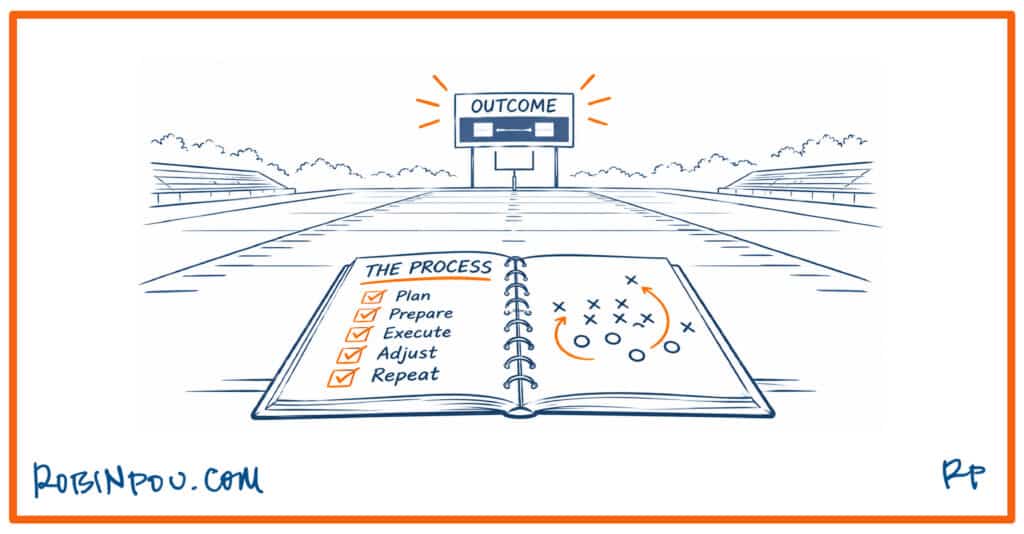
Thoughts Lead to Actions
Saban appears to have focused on three things:
- What is the skill needed?
- What is the process to improve that skill?
- What is the process needed to generate the outcome?
For example, he helped his team focus:
In a football game, a team has roughly 70 plays. Each play is about six seconds.
Saban’s job as the leader became: help your players execute their skill to their maximum effort in six-second increments. Do that seventy times. The scoreboard takes care of itself.
Taking a page out of his playbook looks like this:
- You can’t control those variables outside of your control.
- You can control your focus (not being distracted by the uncontrollable).
- Your leadership is needed to stay focused on the process.
Step 1: Skills and Development
What are the main skills your team needs to execute the project?
What needs to be developed to increase the team’s performance?
How do you develop them? Skills develop through deliberate practice, not good intentions.
Step 2: Application and Breakdown
How do you apply skills to your actual work?
What practice is needed to increase your performance level?
Step 3: Break your game into its component parts.
What are the project elements, phases, or milestones?
What are the “plays” inside each phase?
For example, you’ve gone from “launch by Q4” to a series of phases and plays where each one is something you can master. And when you master the plays, the game takes care of itself.
Boost Your Performance
Learn to map your core skills and break your game into plays with this week’s video.
What’s Your Opinion?
What’s one skill you’ve been avoiding by staying focused on the outcome?
I’d love to hear your thoughts: robin.pou@robinpou.com
If you are going to be a leader, you might as well be a good one. Don’t let doubt count you out. Have a confident week!

Robin Pou, Chief Advisor and Strategist
We live to make bad leadership extinct so forward this newsletter to others who strive to be confident leaders.
SUBSCRIBE TO THE CONFIDENT LEADER
Let’s Connect
Follow me on Linkedin, Facebook and Twitter.
What is “The Confident Leader”?
During the Covid-19 Pandemic, I began a video series called “Panic or Plan?” It was designed to equip leaders to navigate the doubt they experienced and to rise in the confidence they needed to lead during turbulent times. It took off. I then started this newsletter to equip leaders in the same fashion each week for the doubt that crashes across the bow of their leaderSHIP.
